Automation Is Reshaping Cable & Wire Harness Manufacturing
Cable and wire harness manufacturing has traditionally relied on skilled manual assembly due to product variability, routing complexity, and connector diversity. However, rising quality expectations, labor constraints, and increasingly sophisticated electronic systems are accelerating the adoption of robotics, machine vision, and digitally integrated automation.
This shift is not about replacing human expertise. It's about enhancing precision, improving repeatability, and building more resilient manufacturing ecosystems. For OEMs, that translates directly into higher product consistency, scalable production capacity, and improved supply chain stability. Manufacturers investing strategically in automation are increasingly setting the benchmark for quality, traceability, and operational efficiency across electronics industries.
Where Robotics Are Delivering Measurable Value
Automated Wire Processing and Termination
Robotics are now widely deployed in upstream wire preparation processes, including:
- Precision cutting and stripping
- Automated crimp termination
- Terminal insertion verification
- Pull-force validation and electrical continuity testing
Servo-controlled crimping presses paired with robotic handling deliver consistent termination geometry, a critical factor in long-term electrical reliability, EMI performance, and regulatory compliance. Real-time process monitoring further reduces variability and improves yield predictability.
Harness Assembly and Routing Automation
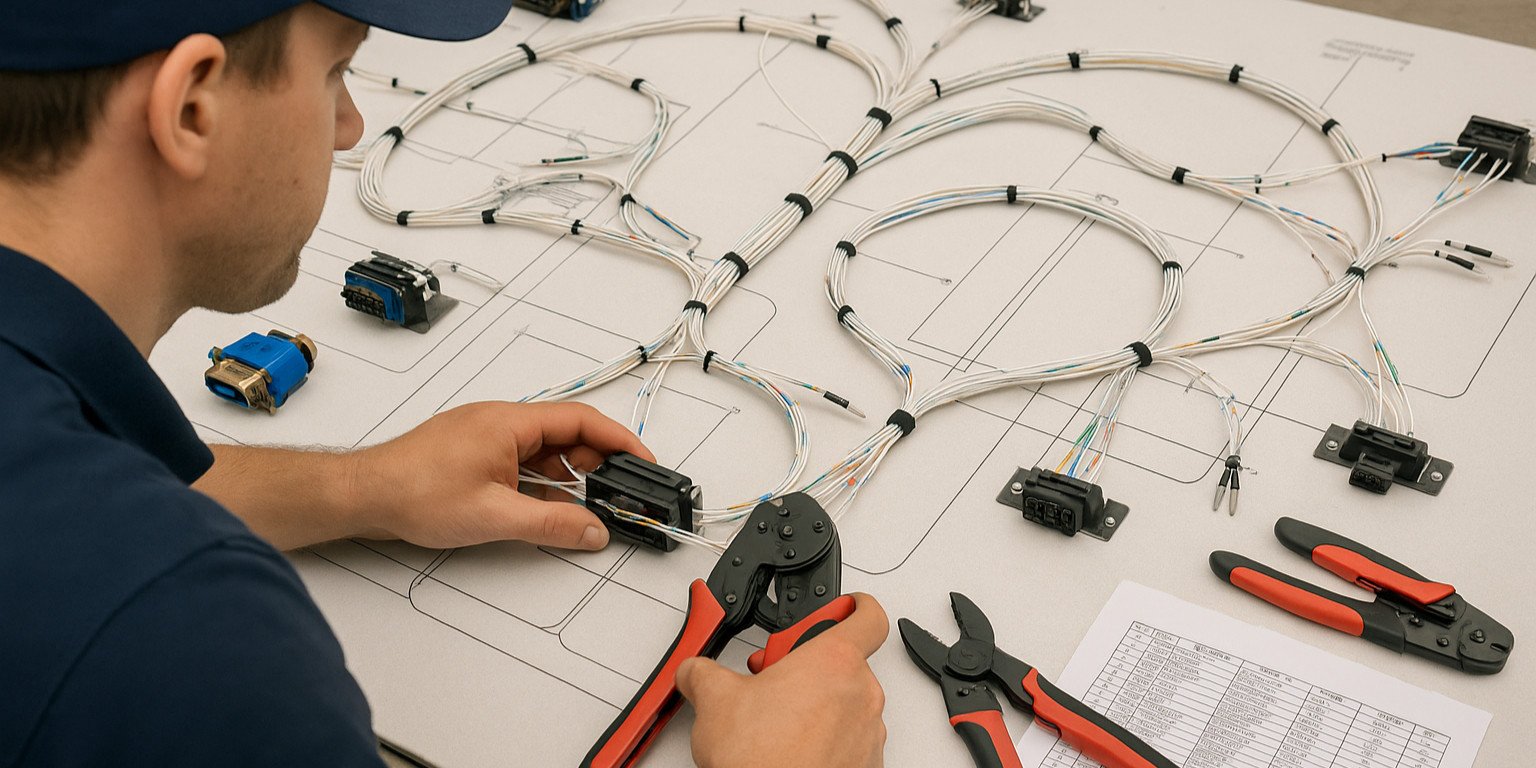
Harness routing has historically been difficult to automate due to flexible materials and complex geometries. New robotic technologies are changing that through:
- Multi-axis robotic manipulators with adaptive gripping
- Programmable harness boards and automated positioning fixtures
- Force-feedback systems that replicate human dexterity
While not every harness configuration can be fully automated, hybrid robotic workflows improve repeatability, reduce ergonomic strain, and enable faster production scaling.
Connectorization and Subassembly Integration
Robotic systems are increasingly used for:
- Connector insertion and engagement verification
- Shield termination processes
- Electromechanical subassembly integration
- Preparation for overmolding or encapsulation
These applications benefit from robotic precision, reducing defects that can affect performance, shielding effectiveness, or mechanical durability.
Machine Vision: The Backbone of Modern Quality Control
Robotics drive automation efficiency, but machine vision enables confidence in quality outcomes.
Today’s vision systems provide continuous inspection capabilities that extend far beyond traditional manual checks.
Common Machine Vision Applications
- Crimp profile and termination verification
- Wire color sequence validation
- Connector orientation confirmation
- Label placement and barcode readability
- Detection of insulation defects or routing anomalies
AI-assisted image analysis enables inspection speeds and consistency that manual methods simply cannot match, supporting real-time quality assurance rather than post-production detection.
Traceability and Digital Quality Infrastructure
Modern vision systems increasingly integrate with manufacturing execution systems (MES) and quality management systems (QMS), creating robust digital production records.
This supports:
- Serialized product traceability
- Automated inspection documentation
- Faster root-cause analysis
- Audit readiness and regulatory compliance
- Improved recall responsiveness
For regulated sectors such as medical devices, aerospace electronics, and automotive safety systems, this level of traceability is becoming a baseline expectation.
Collaborative Robotics Enable Flexible Automation
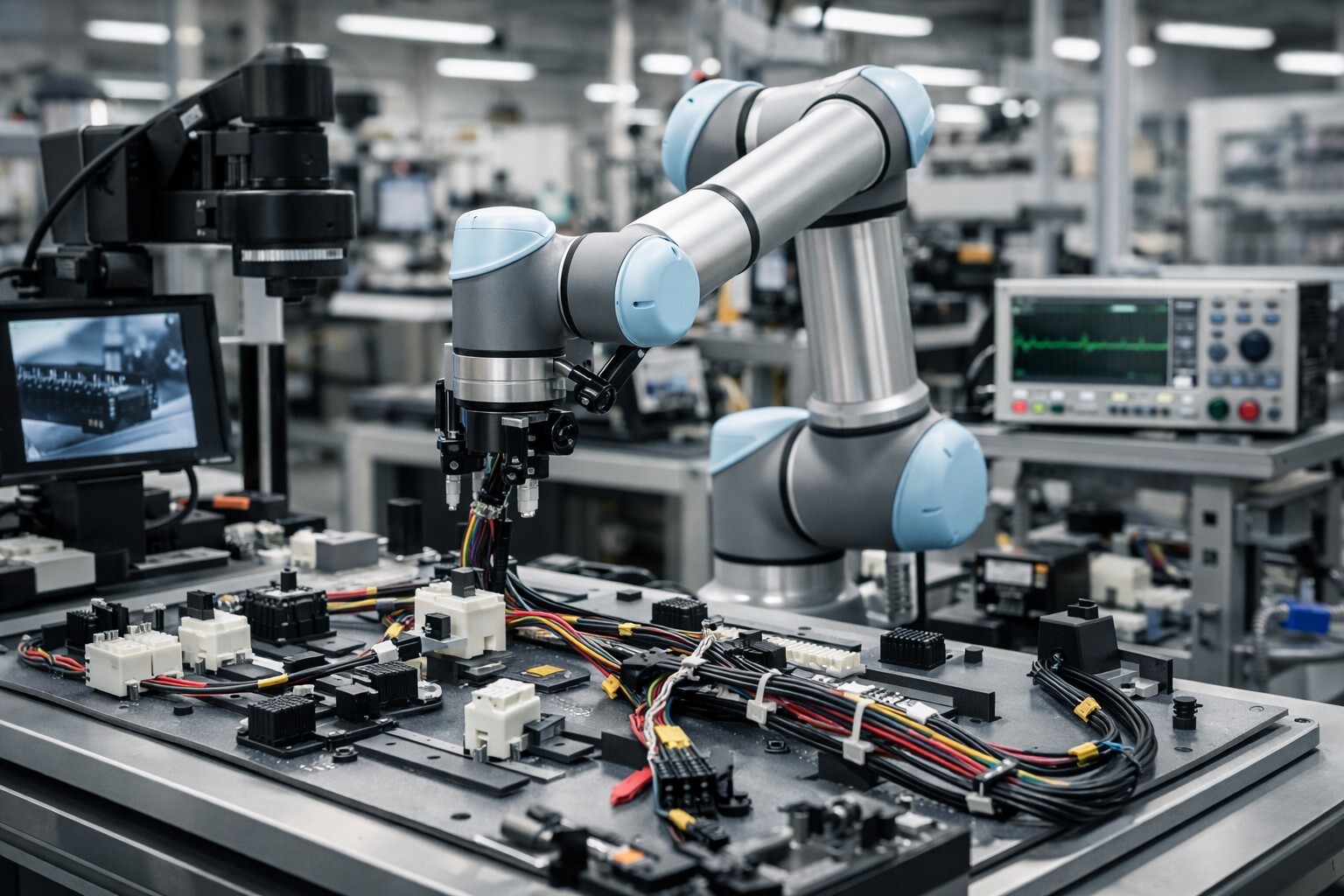
Collaborative robots (cobots) are expanding automation adoption because they combine robotic precision with human adaptability.
Advantages include:
- Smaller footprint and faster deployment
- Safe operation alongside technicians
- Lower capital investment compared to traditional automation cells
- Flexibility for medium-mix manufacturing environments
Cobots commonly assist with routing support, inspection positioning, connector insertion, and repetitive subassembly tasks. This improves productivity without sacrificing customization capability.
AI and Predictive Manufacturing Are the Next Frontier
Artificial intelligence is increasingly transforming manufacturing automation from reactive quality control to predictive process optimization.
Emerging capabilities include:
- Early defect pattern detection
- Predictive maintenance alerts for tooling wear
- Automated process optimization insights
- Continuous improvement of inspection algorithms
These advancements help prevent defects before they occur, improving yield stability and reducing downstream quality risks.
Strategic Benefits for OEMs
Automation maturity is becoming a key differentiator when evaluating manufacturing partners.
Quality Consistency
Automation reduces human variability, supporting tighter tolerances and improved reliability.
Scalable Production Capacity
Automated workflows allow rapid scaling without proportional increases in labor dependency.
Enhanced Compliance and Traceability
Digital inspection records simplify regulatory documentation and audit preparation.
Cost Stability
Automation helps mitigate labor volatility and supports predictable long-term pricing.
Faster Time to Market
Automated processes accelerate transitions from first-article to full-scale production.
Implementing Automation Requires Strategic Alignment
Successful automation implementation involves more than equipment investment. It requires coordination across:
- Design for manufacturability (DFM)
- Tooling and fixture standardization
- Process engineering integration
- Digital infrastructure readiness
- Global production alignment
Manufacturers combining engineering expertise, automation investment, and global operational experience are best positioned to deliver sustainable ROI.
The Future: Toward the Smart Harness Factory
Over the next several years, cable and harness manufacturing will continue evolving toward:
- Fully digital manufacturing ecosystems
- AI-enhanced inspection autonomy
- Flexible robotics supporting high-mix production
- Greater regional manufacturing flexibility
- Deeper integration between design, manufacturing, and supply chain data
These developments will be essential as electronic systems become more compact, performance-critical, and regulated.
How Sanbor Manufacturing Supports Automated Cable & Harness Production
Automation delivers the most value when it is integrated into a broader manufacturing strategy that includes engineering expertise, quality infrastructure, and global production flexibility.
At Sanbor Manufacturing, automation investments are combined with:
- Advanced cable and wire harness manufacturing capabilities
- Machine vision–enabled inspection and traceability systems
- Integrated electromechanical assembly and box build expertise
- Global manufacturing locations supporting regional supply-chain strategies
- Quality systems aligned with high-reliability and regulated industries
This approach helps OEMs achieve consistent product quality, scalable production capacity, and supply chain resilience in an increasingly complex electronics landscape.
Organizations that align early with automation-driven manufacturing partners position themselves to move faster, reduce operational risk, and maintain competitive advantage as manufacturing technologies continue evolving.