As electronics continue to shrink while performance demands accelerate, OEMs are under increasing pressure to do more with less space. Higher data rates, greater power density, and expanding sensor networks are all being packed into increasingly compact enclosures. At the center of this challenge sits one critical component - the high-density wire harness.
Designing high-density harnesses is no longer an edge case reserved for aerospace or defense. It is now a standard requirement across industrial automation, medical devices, automotive electronics, and advanced computing platforms. Success depends on thoughtful engineering decisions made early, before routing constraints, EMI issues, or assembly limitations become costly problems.
This article explores the core design principles behind reliable, manufacturable high-density wire harnesses and how OEMs can avoid the most common pitfalls.

Why Demand for High-Density Harnesses Keeps Rising
Across nearly every industry, product architectures are evolving in the same direction:
-
Smaller and lighter form factors
-
Higher data throughput and faster signal speeds
-
Increased power distribution within confined spaces
-
More sensors, controls, and connectivity points
Avionics systems pack unprecedented functionality into limited aircraft real estate. Medical electronics must deliver accuracy and reliability while remaining compact and portable. Industrial equipment integrates more intelligence without expanding enclosure size. In each case, wire harness density increases—not by choice, but by necessity.
As OEMs push the limits of packaging efficiency, wire harness manufacturing services must evolve to support tighter tolerances, higher pin counts, and more complex electrical architectures.
Core Design Considerations for High-Density Harness Engineering
1. Conductor and Insulation Selection
Material selection is foundational in dense harness design. To reduce overall bundle diameter while maintaining flexibility and durability, engineers often rely on:
-
Fine-stranded conductors to improve bend radius and routing flexibility
-
Thin-wall insulation to minimize outer diameter without sacrificing performance
-
High-temperature insulation materials for confined or heat-prone environments
Materials such as PTFE, FEP, and advanced TPE compounds can dramatically reduce harness size while supporting demanding electrical and environmental requirements. When combined with proven custom cable assembly manufacturing processes, these materials allow OEMs to maintain electrical performance without increasing enclosure size.
2. Smart Routing Starts at the Design Stage
In high-density harnesses, routing is a primary design constraint. Effective routing strategies include:
-
Minimizing wire crossovers to reduce bulk and assembly complexity
-
Using controlled, layered routing paths rather than random bundling
-
Maintaining consistent cable paths to improve repeatability at scale
-
Physically separating noise-sensitive signal lines from power conductors
-
Modeling harness paths in 3D CAD to identify interference early
OEMs that engage early design-for-manufacturing support are far more likely to identify routing conflicts before they become production delays or cost drivers.
3. Connector Selection Directly Impacts Density
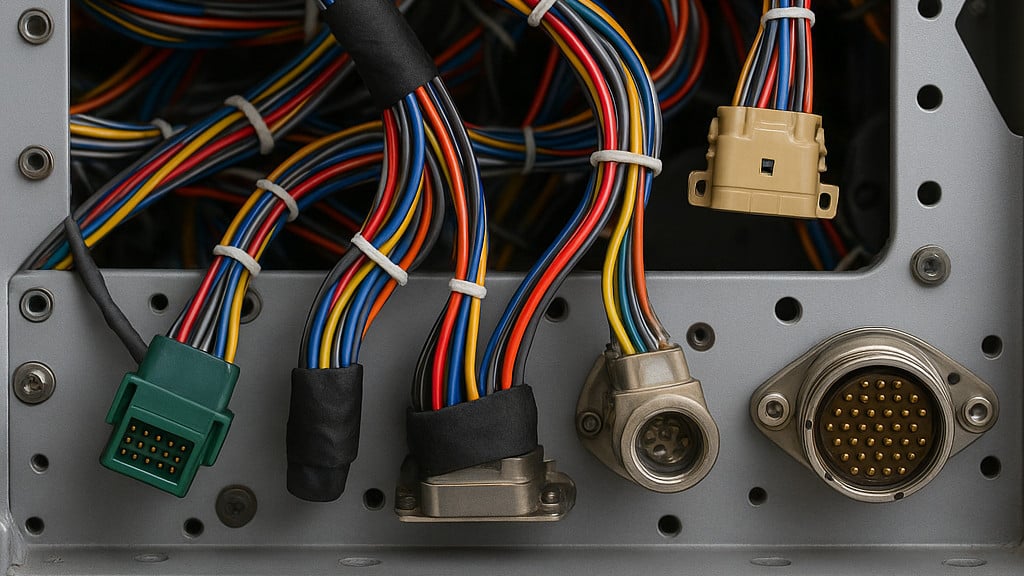
Connectors often determine whether a design succeeds or fails from a packaging standpoint. High-density harnesses commonly leverage:
-
Micro-connectors and fine-pitch interfaces
-
Multi-pin headers to reduce interface count
-
Custom or overmolded connectors for space and strain-relief optimization
-
Locking or latching mechanisms in vibration-prone environments
Selecting an oversized or poorly matched connector can increase overall harness volume by 20–40 percent, instantly undermining the design intent and limiting scalability.
Managing EMI, Heat, and Signal Integrity in Tight Spaces
As conductor density increases, so does susceptibility to electromagnetic interference and thermal buildup. These issues are magnified in high-speed data and mixed-signal applications.
Mitigation strategies typically include:
-
Shielded twisted pairs for sensitive data lines
-
Physical separation of power and signal conductors where feasible
-
Braided or foil shielding to suppress EMI
-
Intentional airflow or heat dissipation paths within the enclosure
-
Low-loss dielectric materials for high-frequency signals
Maintaining IPC Class 3 workmanship standards is especially critical in aerospace, medical, and mission-critical electronics where EMI or signal degradation can result in system failure.
Assembly and Testing: Where Density Challenges Multiply
Designing a high-density harness is only half the challenge. Manufacturing execution requires precision and discipline.
High-density assemblies often demand:
-
Micro-crimping and specialized termination tooling
-
Controlled strip lengths and tight process tolerances
-
Magnified visual inspection to identify workmanship defects
-
Automated electrical testing for continuity, resistance, and HiPot
-
Properly engineered strain relief for small, delicate connectors
OEMs planning growth must ensure these controls can scale reliably. Many quality issues surface when transitioning from prototype to volume production without standardized processes.
Sanbor Manufacturing’s Role in High-Density Wire Harness Success
Sanbor Manufacturing brings extensive experience supporting OEMs designing and producing high-density wire harnesses across aerospace, medical, industrial, electronics, and automotive applications.
Core capabilities include:
-
Advanced micro-connector termination and fine-pitch assemblies
-
High-density routing, bundling, and harness optimization
-
Consistent IPC Class 3 workmanship standards
-
Scalable production across a global wire harness manufacturing footprint
-
Reliable component sourcing and supply-chain continuity
-
Seamless transition from low-volume builds to full production
Sanbor’s global manufacturing model enables OEMs to reduce risk, control cost, and maintain consistent quality across regions.
Final Takeaway
High-density wire harness design is inherently complex, but it is entirely manageable with the right engineering discipline and manufacturing partnership.
By addressing routing, connector selection, materials, EMI control, and assembly requirements early in the design process, OEMs can avoid downstream risk while improving both performance and manufacturability.
With deep technical expertise and a globally scaled production model, Sanbor Manufacturing helps OEMs bring next-generation, high-density harness designs to market—reliably, efficiently, and at scale.
Ready to get started? Call us at 610.530.8500, email sales@sanbormfg.com or connect through our quick online contact form.